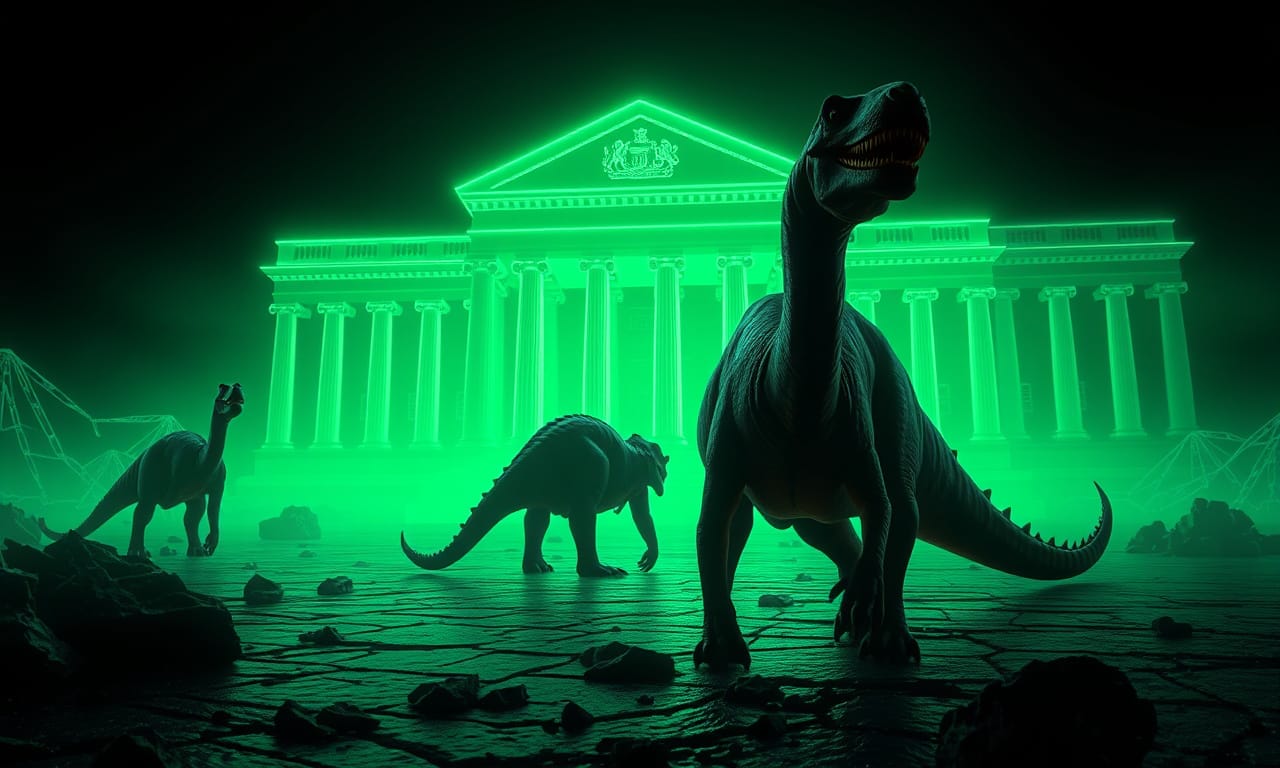
Hook: A Joke They Don't Get
What's the difference between a bank CEO and a dinosaur? The dinosaur's extinction event wasn't self-inflicted. I'm sitting here, staring at three screens glowing with panic-red and hope-green candlesticks, the stench of cold coffee and cheaper whiskey in the air. The news ticker scrolls: "Major Banking Consortium Calls for 'Preemptive Regulatory Pause' on Digital Asset Innovation." I let out a laugh that sounds more like a cough. They're doing it again. The suits, the marbled lobbies, the legacy system built on toll bridges and velvet ropes - they're trying to pull the emergency brake on a bullet train they don't own tickets for. Big banks want to freeze innovation. History says that's a mistake. Let me tell you why this is the most bullish signal you'll get all year.
The Facts: The Technical Deep Dive into the Power Grab
Don't let the polite, Fed-speak fool you. This isn't about "consumer protection" or "systemic risk." That's the wallpaper. This is a raw, naked power play. The technicals are simple: they're trying to fork the legal code. The proposal, buried in 200 pages of bureaucratic oatmeal, boils down to a few key attack vectors. First, they want to redefine what constitutes a "security" so broadly that every token from Bitcoin to a dog-themed meme coin would need to register with the SEC - a process designed to be costly, slow, and impossible for decentralized networks without a central issuer. It's like demanding a forest get a business license.
Second, they're pushing for KYC/AML requirements at the protocol level. Imagine needing a passport to use TCP/IP. They want to hard-code surveillance into the base layer, turning every node into a potential snitch for the financial Stasi. The tech doesn't work that way, but they don't care. If they can't control the protocol, they'll criminalize anyone who builds the on-ramps - the exchanges, the wallet providers, the developers.
Finally, and most insidiously, they're lobbying to ban algorithmic stablecoins and severely restrict decentralized finance (DeFi) "until more research is done." Translation: until their own, private, permissioned, blockchain-lite ledgers are ready for prime time. They don't hate the technology. They hate the fact that it's permissionless. They see open-source code as a leak in their monopoly. This is a coordinated, legacy-system immune response. Big banks want to freeze innovation. History says that's a mistake, and the technical blueprint of their attack proves they know they've already lost the ideological war.
Market Impact: What Happens to Your Bags? (BTC/ETH/Alts)
Panic sells. Smart money buys. We've been here before. Remember the China FUD cycles? The Mt. Gox collapse? The ICO crackdown? Each was an extinction-level event for weak hands and a fire sale for those with diamond hands and a sense of history.
Bitcoin (BTC): It will dip. Maybe hard. The headlines will scream. Then it will bounce. Why? Because Bitcoin is the antithesis of their system. It's the hedge against their very existence. Every attack makes its value proposition clearer. It's digital gold, and you don't ask a bank's permission to bury gold in your backyard. The hash rate won't budge. The network won't care. This is noise for BTC, but a buying opportunity.
Ethereum (ETH): More complex. The SEC has always had a hungry eye on ETH. The narrative of "ultra-sound money" and the world's decentralized settlement layer runs headfirst into their regulatory land grab. Expect volatility. But also remember: the Ethereum ecosystem - the DeFi, the NFTs, the DAOs - is the exact nightmare the banks are having. They can't freeze a smart contract. They can't reverse an immutable transaction. Short-term pain, long-term existential validation for the ETH thesis.
The Alts: Here's where the bloodbath and the glory separate. The true shitcoins, the VC dumpster fires, the projects with a "CEO" and a legal team - they're dead. They'll be regulated out of existence, and good riddance. But the truly decentralized, community-driven, purpose-built alts? The Moneros (XMR), the Litecoins (LTC), the decentralized oracle networks? They'll go to ground. Development will continue on GitHub, discourse will move to encrypted channels, and liquidity will become more peer-to-peer. It's a purification ritual. The weak die, the strong evolve. Your bags get lighter but more valuable.
Whale Watch: What Is Smart Money Doing?
Stop watching the retail panic on Twitter. Look at the chain. I'll tell you what the whales are doing. They're accumulating. OTC desk volumes are up. Large, block trades of BTC and ETH are settling off-exchange to avoid moving the spot price. The stablecoin reserves on major exchanges are draining - a sign money is moving off-ramp to buy the coming dip.
More tellingly, the venture capital that was flooding into "Web3" consumer apps is now quietly, furiously, pivoting to infrastructure. Zero-knowledge proofs, privacy layers, decentralized identity, and cross-chain communication protocols. The smart money isn't betting on the next ape JPEG; it's betting on the picks and shovels for the crypto underground. They're funding the tools that will make regulation irrelevant. They're investing in crypto's immune system. The whales see this regulatory blitzkrieg not as an end, but as a phase change. They're positioning for the next cycle, where the tech is stronger, more resistant, and more obviously necessary than ever. They've read the history books. Big banks want to freeze innovation. History says that's a mistake, and their wallets are voting accordingly.
The FUD Check: Is This Noise or Signal?
This is both. It's critical signal wrapped in a blanket of noise.
The Noise: The daily price swings, the hysterical YouTube livestreams, the breathless articles about "the end of crypto." This is emotional static. Ignore it.
The Signal: This is the loudest, clearest signal yet that the incumbent system feels existentially threatened. They wouldn't be mobilizing their vast lobbying arsenals, risking their reputations with blatantly anti-innovation rhetoric, if they were winning. They're not. DeFi, despite the bear market, has permanently changed expectations for finance. Non-custodial ownership is a genie that won't go back in the bottle. The signal is their desperation.
Remember: Innovation doesn't happen in boardrooms. It happens in garages, on Discord servers, and in the lines of open-source code. The internet wasn't built by AT&T. The personal computer wasn't invented by IBM (they tried to kill it). The banks are playing a game of Whac-A-Mole with a hydra. For every exchange they pressure, three privacy DEXs appear. For every stablecoin they target, algorithmic reserves evolve. The signal is that the battle lines are now drawn in the open. The war is official. And in war, you get clarity.
Conclusion: Final Verdict from the Trenches
My coffee's gone, the whiskey too. The screens still glow. The verdict isn't complicated. This is a testament. A stress test. And a gift.
The legacy financial system, with its trillions in assets and marble-columned legitimacy, is formally acknowledging its greatest threat since the invention of double-entry bookkeeping. They are scared. They should be. Their model - custodial control, rent-seeking, gatekeeping information and access - is being rendered obsolete by a few lines of code running on a global, permissionless computer.
They will win some battles. They will strangle some companies. They will create regulatory moats around certain areas. But they will lose the war. The fundamental mathematics of cryptography, the distributed nature of consensus, the human desire for sovereign ownership - these forces are more powerful than any lobbying group. The cost of coordination for them is astronomical. For us, it's a GitHub repo.
So, buy the fear. Build the tools. Contribute to the code. The wheel of history turns. The stagecoach companies sued the railroads. The record labels sued Napster. The newspapers sued the bloggers. And now, the big banks want to freeze innovation. History says that's a mistake. It's the same chapter, just with different characters. The dinosaurs are shaking the ground with their roars, but the mammals are already scurrying in the underbrush, adapting, and waiting for the comet dust to settle. Be a mammal.
The future isn't asking for permission. It's publishing its code and forking the system. The only question is, are you building the new one, or are you standing in the marble lobby of the old one, yelling at the tide?