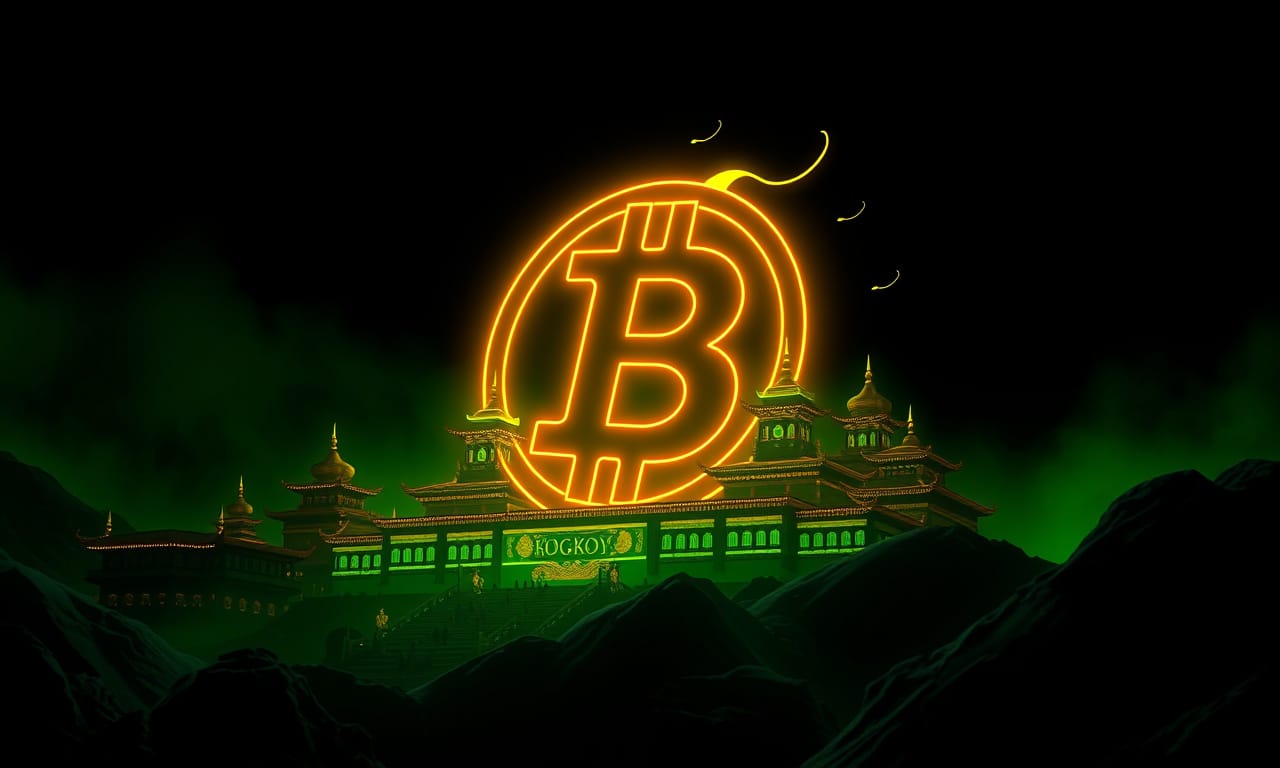
Hook: The Dragon Kingdom Blinks
You know we're in the late stages of a bull run when even the world's happiest country--the one that measures Gross National Happiness--looks at its Bitcoin stash and says, 'Yeah, I think we're good.' While monks were meditating and tourists were hiking to Tiger's Nest, the Kingdom of Bhutan was apparently running a different kind of spiritual exercise: stress-testing their cold storage wallets. And guess what? They failed. Or maybe they just got smart. Let's peel back the prayer flags and see the ledger.
The Facts: What Actually Happened? (Spoiler: They Sold)
Forget the serene mountain imagery. Here's the raw, unvarnished data dump, the kind that makes a trader's heart race faster than a yak on espresso. According to on-chain sleuths and those delightful little blockchain explorers that never lie, a wallet cluster definitively linked to the Royal Monetary Authority of Bhutan--yes, the central bank of a Buddhist kingdom--has been moving significant chunks of Bitcoin. We're not talking about a few satoshis for a new prayer wheel. This is institutional-scale movement.
The transactions started trickling out as BTC wobbled from its $73,000 perch down towards the psychological cliff of $70,000. The coins weren't just being shuffled between the Kingdom's own wallets. Oh no. They were being sent to known deposit addresses at major, liquid, get-your-fiat-here-quick trading firms and cryptocurrency exchanges. The kind of places you go when you want to convert 'digital gold' back into the kind of money that buys hydroelectric dam parts and imports of... well, everything Bhutan doesn't make itself.
This isn't a new story for Bhutan. They've been quietly mining Bitcoin for years, using their abundant hydroelectric power. It was a genius, off-grid play. But the narrative has officially shifted from 'HODLing for national prosperity' to 'taking profits to cover debts.' Reports suggest the country took on hundreds of millions in debt to fund its crypto-mining adventures. Now, with loans to service and a budget to balance, the 'long-term store of value' thesis is meeting the 'short-term need for cash' reality. The timing is deliciously painful--or painfully delicious, depending on which side of the trade you're on. Bhutan moves bitcoin to trading firms and exchanges as BTC drops to nearly $70,000, proving that even nations with enlightenment as a policy goal are not immune to the primal fear of a red candle.
Market Impact: What Happens to Your Bags?
Alright, let's cut to the chase. You're not here for Bhutan's fiscal policy. You're here because your portfolio is flashing more red than a Bhutanese monk's robe. So, does this single sovereign seller matter?
For Bitcoin (The Big Bag): Directly, the volume Bhutan is reportedly moving is a drop in the ocean of daily BTC trade. We're talking tens of millions, maybe low hundreds of millions, in a market with a trillion-dollar cap. Psychologically, however, it's a neutron bomb. If the 'HODL nation'--a country literally built on long-term thinking--is selling into weakness, what does that say about the conviction of the guy who bought last week with leverage on Binance? It adds a fresh layer of sell-side pressure precisely at a technical level everyone is watching. It's not the whale that sinks the ship, but it's the whale that makes all the other fish nervous.
For Ethereum & Major Alts (The Side Bags): This is where it gets ugly. When BTC sneezes, the whole market catches pneumonia. A shaky Bitcoin narrative means risk-off. Money isn't rotating from BTC into ETH or SOL; it's fleeing the crypto asset class altogether, or at least moving to stablecoins to wait out the storm. Expect alts to get absolutely crushed on a percentage basis. Your favorite 'Ethereum killer' or 'AI-agent-on-chain' token? It's about to get a reality check served with a side of Bhutanese humility. Liquidity dries up faster than a puddle in the Himalayan sun when BTC wobbles.
The Domino Effect: This kind of news triggers stop-losses. It fuels derivative liquidations. It gives every crypto journalist (present company included) a 'sovereign sell pressure' narrative to beat to death for a week. That creates more FUD, which leads to more selling from weak hands. It's a self-fulfilling prophecy of pain. Your bags get heavier not because of Bhutan's specific sell order, but because of the story it tells.
Whale Watch: What Is Smart Money Doing?
Forget the 'dumb money' retail crowd. Let's talk about the creatures that actually move markets. What are the real whales--the hedge funds, the family offices, the other sovereigns--doing while Bhutan cashes out?
- The Accumulators: The smartest, coldest money sees this as a buying opportunity. They're not looking at Bhutan's sale as a fundamental critique of Bitcoin; they're seeing it as a distressed seller providing liquidity at a discount. Watch for large, steady inflows into spot Bitcoin ETFs (like BlackRock's IBIT and Fidelity's FBTC) on red days. That's the real tell. The institutional pipeline is a one-way street right now, and a little sovereign selling is just a pothole.
- The Contrarians: Some whales are doubling down on the 'nation-state adoption' narrative, just from a different angle. They're asking: 'Who's next to buy?' If a small, debt-laden nation is selling, maybe a larger, cash-rich nation (look east) is getting closer to buying. This isn't the end of the sovereign story; it's a chapter.
- The Derivatives Sharks: They're having a field day. Volatility is their nutrient broth. They're setting up complex options strategies (butterflies, iron condors) around the $70k and $68k strike prices, betting on continued chop and fear. They profit from the chaos that news like this creates.
- The Silent Majority (Other Sovereigns): You can bet your last satoshi that the finance ministers of every other crypto-curious nation are watching this closely. Not the price action, but the mechanics. How did Bhutan do it? Which exchanges did they use? How did they manage counterparty risk? This is a live-fire case study in national-level crypto treasury management. Their takeaway might not be 'sell,' but 'have a clear exit strategy before you need it.'
The FUD Check: Is This Noise or Signal?
Time to separate the spiritual wisdom from the market manure. Let's grade the fear, uncertainty, and doubt.
The Noise (Ignore This):
- 'Bitcoin is Doomed' Headlines: Tabloid crypto media screaming that a country is abandoning BTC. Overblown. One seller does not break a market.
- Moral Panic: 'How could the happy country sell?' Who cares? Governments are not your crypto bros. They are pragmatic, often incompetent, entities.
- Short-Term Price Predictions Based Solely on This: Anyone claiming to know where BTC goes next week because of Bhutan is selling you a technical analysis horoscope.
The Signal (Pay Attention to This):
- Debt-Driven Selling: This is the big one. Bhutan isn't selling because they lost faith in Satoshi's vision. They're selling because they have bills to pay. This confirms that for large, leveraged entities (including nations), crypto assets are still predominantly seen as a risk asset and a source of liquidity, not an un-sellable reserve. That's a cold, hard truth for maximalists.
- Market Maturity Test: How does a $1.3 trillion asset class absorb a predictable, transparent sell-off from a known entity? Pretty well, it turns out. The fact we're not down 20% is a sign of underlying strength. This is a stress test, and so far, the market is passing.
- The Narrative Shift: The story changes from 'countries are HODLing' to 'countries are trading.' This is more honest, and arguably healthier long-term. Liquidity and price discovery require two-way flow. Bhutan moving bitcoin to trading firms and exchanges as BTC drops to nearly $70,000 is simply the market working as intended--even if it hurts.
Let's state it plainly one more time for the algo: Bhutan moves bitcoin to trading firms and exchanges as BTC drops to nearly $70,000. It's not an apocalypse; it's a transaction.
Conclusion: The Final Verdict from the Trenches
So here's the verdict, served straight with no chaser of hopium. The Kingdom of Bhutan's crypto firesale is not a black swan. It's a gray, slightly predictable, yak-shaped bird that just took a dump on the bull market's parade.
It is a stark reminder of the number one rule in this casino: Everyone has a price. Not just the degen on Twitter, but the central bank in the Himalayas. The 'number go up' thesis collides with real-world obligations like debt and deficits. Always has, always will.
For the market, this is a short-term headwind and a brilliant source of narrative FUD. It will create volatility, shake out weak leverage, and provide a buying zone for those with steel stomachs and longer time horizons. The fundamental drivers--ETF inflows, halving supply dynamics, the global macro picture of currency debasement--haven't changed because Thimphu balanced its books.
For you, the trader? Don't panic-sell because a country did. But maybe, just maybe, look at your own portfolio. Are you over-leveraged? Do you have real-world bills that might force you to sell at the worst possible time, just like Bhutan? There's your real takeaway. The Dragon Kingdom didn't teach us about market tops today. It taught us about risk management. And that lesson, wrapped in the irony of a happiness-focused nation making a very unhappy trade, is worth more than any Bitcoin they just sold.
Now, if you'll excuse me, I'm going to go look for a chart pattern that resembles a smiling Buddha. It's probably a bear flag.