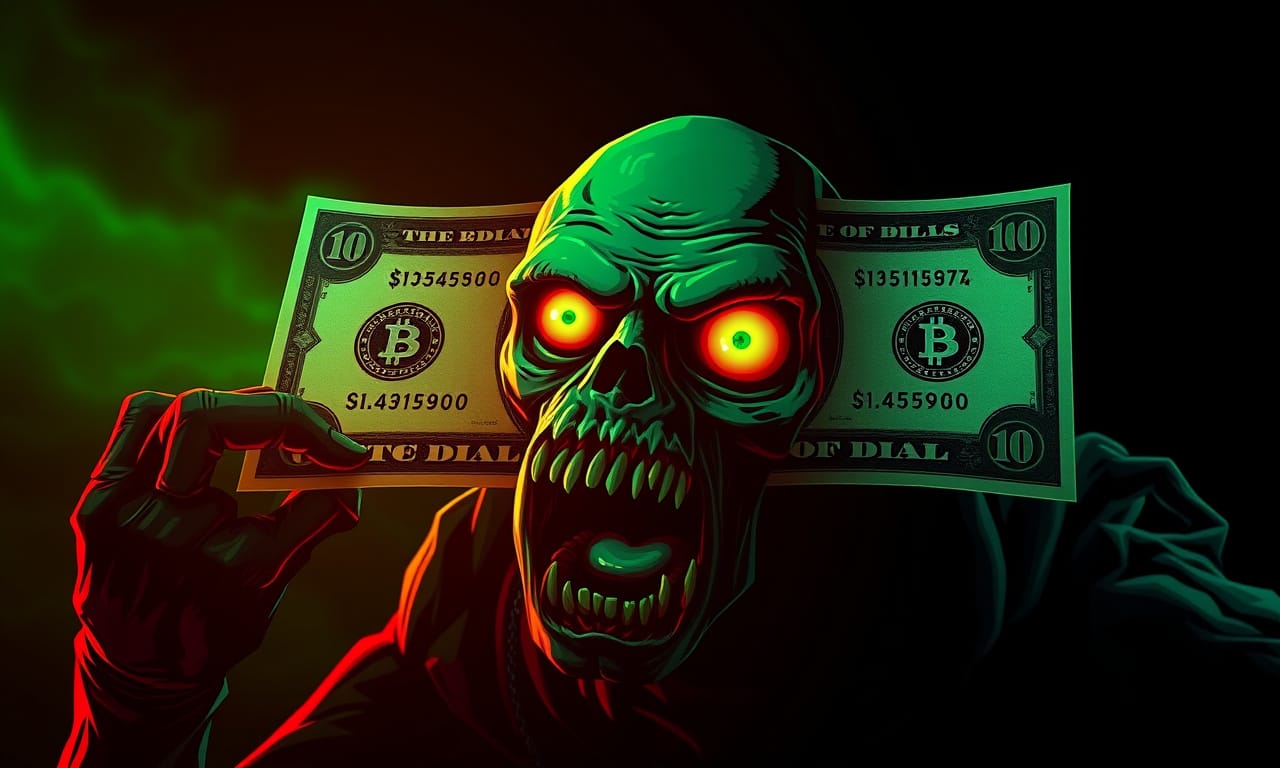
They're Baaaack...
You ever see a horror movie where the monster just won't die? You stab it, shoot it, set it on fire, and just when you think you can finally relax and count your unrealized gains, a gnarled, bureaucratic hand bursts from the legislative grave. That's the Lummis-Gillibrand Financial Innovation Act, or as I call it, 'The Creature from the Swamp Lagoon.' They told us it was dead. They whispered it had 'slipped off the calendar.' They hoped we'd forget. But in Washington, nothing good ever truly dies--it just gets a new co-sponsor and a worse haircut. The big crypto bill isn't dead, may return next month as Wall Street fight still looms. Grab your coffee, and maybe a stiff drink. We're going in.
The Facts: A Technical Autopsy of a Legislative Frankenstein
Let's strip the press release platitudes and look at the cold, hard, ugly mechanics. The bill, a sprawling 300-page doorstop, aims to do the impossible: please everyone. It wants to give the CFTC more power (good luck with that budget, guys), create some semblance of rules for stablecoins (too little, too late), and draw a line between a 'digital commodity' and a 'digital asset security.' That last part is the whole game. It's the regulatory equivalent of trying to separate siamese twins with a butter knife.
The process died last month not because of a principled stand, but because of the congressional calendar--a chaotic mess of recesses, fundraisers, and performative shouting. Key committees couldn't agree. Banking Chair Sherrod Brown, who looks at crypto like it's a moldy sandwich, wasn't having it. But here's the twist: they've quietly been shoveling coal into the furnace. Staffers are working through the break. Lobbyists are circling like vultures over a dying calf. The plan is to attach it to a 'must-pass' vehicle--maybe a budget bill, maybe a defense bill. Something big and ugly that no one will read. They'll sneak it in during the lame-duck session after the elections, when everyone is exhausted and just wants to go home. That's how sausage--and terrible policy--gets made.
This isn't about 'innovation' or 'clarity.' It's a turf war. The SEC, under Gary Gensler--the man who stares at an orange and calls it a security--wants it all. The CFTC, the scrappier, poorer cousin, sees a massive new revenue stream in registration fees. And Wall Street? Wall Street is in the backroom, writing the provisions that will ensure only they can afford to play. Think 'accredited investor' rules on digital steroids. The big crypto bill isn't dead, may return next month as Wall Street fight still looms precisely because the fight isn't about protecting you. It's about controlling the table.
Market Impact: Will Your Bags Get Rugged by Uncle Sam?
So what happens if this undead abomination lurches across the finish line? Let's talk price action, because that's all that matters in the end.
Bitcoin (BTC): The King. It gets the 'digital commodity' crown. Short-term, a monster rally on 'clarity.' The ETFs get a further green light. Institutional money--the real, boring, pension-fund money--feels a bit safer. But then reality sets in. With clarity comes taxation clarity. With regulation comes surveillance. The libertarian dream takes another hit. Long-term, it becomes a macro asset, pure and simple. Volatility decreases. The 10x moonshots are over. It's digital gold, with a 1099 form.
Ethereum (ETH): The big, messy question mark. The bill tries to create a 'decentralization' test. Does ETH pass? Does proof-of-stake make it more like a security in their eyes? This is the single biggest binary risk event in crypto. If they label it a commodity, it moons alongside BTC. If the SEC successfully argues it's a security... chaos. A delisting event from US exchanges. A black swan that makes FTX look like a minor glitch. My gut? They kick the can. They create a 'transition period' that lasts forever. Bureaucrats love can-kicking.
Altcoins (The Alts): The killing fields. This is where the bill earns its nickname 'The Altcoin Annihilation Act.' Any token with a 'foundation,' a 'marketing budget,' or an 'active development team' is getting a side-eye from the SEC that could turn it to stone. The 'Howey Test' gets a software update. Expect a massive, bloody divergence. The truly decentralized, functional, usage-heavy projects *might* survive. The 10,000 meme coins, the VC-backed 'Ethereum killers' with premined treasuries, the projects where the founders are on Twitter 24/7 promising the world--they are in the crosshairs. This is a purge. Portfolio rebalancing will be violent.
Whale Watch: What the Smart (Dumb) Money is Doing
Don't listen to what they say on CNBC. Watch the wallets.
- The VC Vultures: They're not buying tokens. They're buying politicians. Check the campaign donation filings. They're funding PACs on both sides of the aisle. Their play isn't to bet on a coin--it's to ensure the regulatory outcome gives their portfolio companies an unassailable moat. They want regulation that they can afford to comply with, and you can't.
- The Legacy Finance Infiltrators: BlackRock, Fidelity, Citadel. They're building infrastructure. Custody solutions. Prime brokerage services. They don't care if the price goes up or down 20% this week. They care about building the toll booths on the new financial highway. The bill, for them, is the blueprint for that highway. They're accumulating, but not in the way you think. They're accumulating influence.
- The OG Bitcoin Whales: The silent, ancient addresses from 2010-2013? No movement. They've seen governments come and go. They're not selling. This is just another chapter in the long war. Their strategy is simple: self-custody, wait, and ignore the noise.
- The DeFi Degens: They're doubling down on privacy chains, cross-chain bridges to nowhere, and anonymous governance. They're preparing for the crackdown by going further underground. It's a hedge, but a risky one.
The signal is clear: the big players are preparing for a regulated future, not a banned one. They're betting the big crypto bill isn't dead, may return next month as Wall Street fight still looms, and that the outcome will formalize their advantage.
The FUD Check: Noise vs. Signal in the Echo Chamber
The Twitter threads are apocalyptic. The Telegram groups are screaming 'THEY'RE COMING FOR US.' Is this real, or just another cycle of manic-depressive crypto discourse?
NOISE: The daily headlines. 'Senator X slams crypto!' 'Agency Y launches probe into Project Z!' This is background radiation. It's political theater. It means nothing until a law is passed or a major enforcement action is unsealed.
NOISE: The maximalist tribalism. 'This bill will kill Ethereum!' 'This bill will make Bitcoin illegal!' Extreme, binary outcomes are almost always wrong. The system moves slowly and favors compromise, even if that compromise is stupid.
SIGNAL: The sustained, behind-the-scenes engagement from traditional finance and tech giants. When JPMorgan and Andreessen Horowitz are hiring teams of blockchain lobbyists, it's not because they think this is going away. It's because they're positioning for the endgame.
SIGNAL: The language shift. We've moved from 'ban it all' (2018) to 'how do we regulate it?' (2024). That's a seismic shift. It's an admission of defeat by the prohibitionists. The battle is now over the shape of the cage, not whether there will be one.
SIGNAL: The calendar itself. The fact that leadership is seriously talking about reviving this in a packed, high-stakes lame-duck session is the biggest signal of all. It means the pressure from donors--from both the pro and anti-crypto camps--is immense. Something is going to give.
Final Verdict: Prepare, Don't Panic
Here's the cynical take, forged in the fires of a thousand shitcoin scams and regulatory false dawns:
The bill, or something like it, is inevitable. The US government will not let a multi-trillion dollar market operate in a grey zone forever. The only question is timing and toxicity. The version that passes will be watered-down, compromised, and stuffed with pork-barrel nonsense. It will create as many problems as it solves. It will be outdated by the time the president's signature dries.
But it will be a line in the sand. Post-2024, the game changes. The wild west show starts packing up. The compliant, institutionalized, surveilled, and sanitized era of crypto begins. The profits will be smaller, slower, and taxed. The anarchic dream will fade further into the ether.
Your move?
Diversify jurisdiction. Look at your holdings and ask: 'If the US calls this a security, am I ready?' Understand your own risk profile. Are you a libertarian idealist or a profit-seeking speculator? Your answer dictates your strategy. Most importantly, do not make impulsive trades based on every headline. The big crypto bill isn't dead, may return next month as Wall Street fight still looms--but it's been doing that for two years. They move at the speed of glue. You should move at the speed of light.
The monster isn't under your bed. It's in a markup session. And it's hungrier than you think.