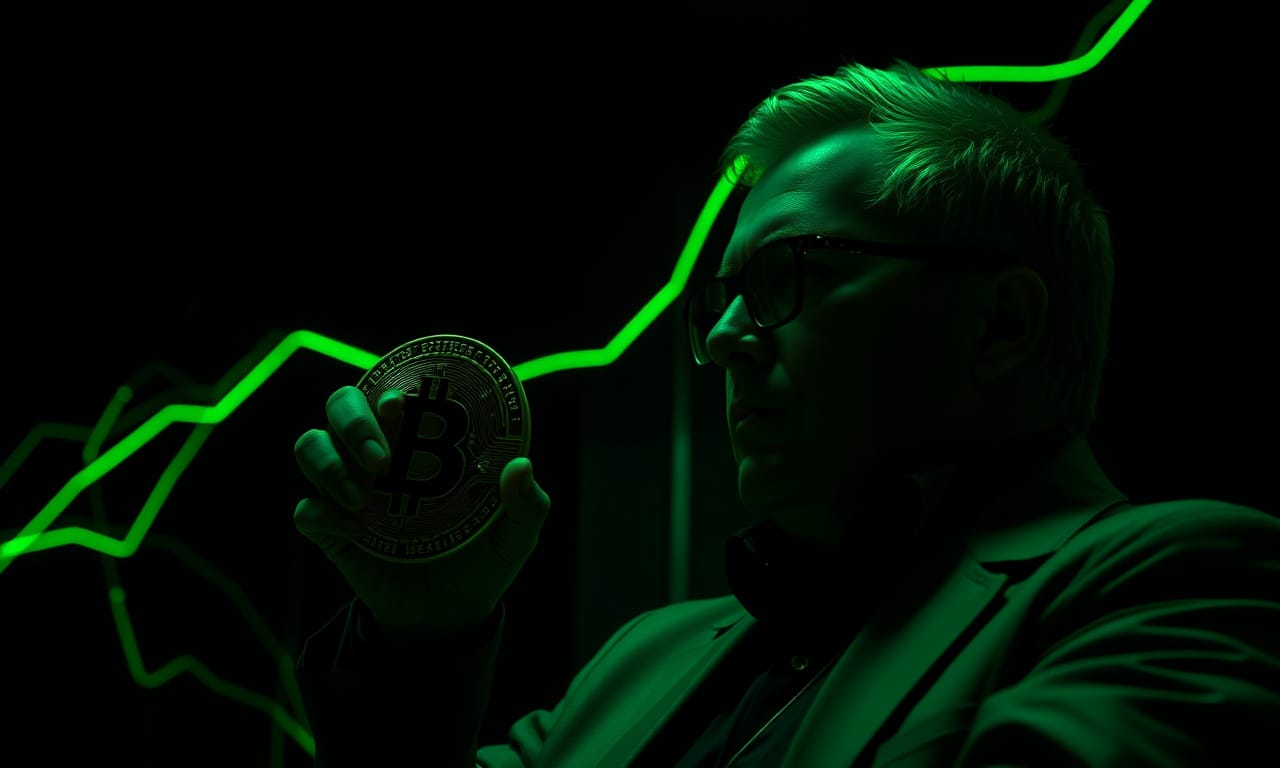
The Quantum Coin Toss
Let's start with a joke that's not funny at all. What do you get when you cross a trillion-dollar asset class with a technology that could crack its foundation like a walnut? Answer: Christopher Wood's latest portfolio move. The Jefferies strategist, a longtime crypto bull who once championed bitcoin as a core holding, just executed a U-turn so sharp it left tire marks on the chart. In his latest Greed & Fear newsletter, Wood announced he was selling the entirety of the bitcoin allocation in his global portfolio--replacing it with physical gold. The reason wasn't regulation, or inflation, or even Elon Musk's latest tweet. It was a specter from the future: quantum computing.
This isn't just another rebalance. This is Jefferies strategist Christopher Wood dropping bitcoin for gold on quantum computing concern, and it's a statement that echoes through trading desks from Wall Street to Crypto Twitter. The man who, for years, told institutional investors to buy the dip, to hold for the long term, to see bitcoin as digital gold 2.0, has now decided the original version looks safer. Why? Because in his view, the very mathematical magic that makes bitcoin secure--the elliptic curve cryptography that guards every wallet and validates every transaction--could one day be undone by a machine that doesn't exist yet. At least not at scale.
The Facts - A Technical Deep Dive Into The Quantum Threat
First, what exactly did Wood say? In his note, he wrote that he was removing the 5% bitcoin exposure in his global portfolio and upping his physical gold allocation from 45% to 50%. The trigger was his reading of a report by the Bank for International Settlements (BIS) about quantum computing's threat to crypto. Let's peel this back to the code level.
Bitcoin's security rests on two cryptographic pillars: the SHA-256 hash function (which creates the digital fingerprint of transactions) and the Elliptic Curve Digital Signature Algorithm (ECDSA), specifically using the secp256k1 curve. ECDSA is what allows you to prove you own a private key without revealing it, enabling you to sign transactions. The security isn't about the encryption being unbreakable--it's about it being computationally impractical to break with classical computers. A quantum computer, leveraging the bizarre laws of quantum mechanics, could change that game entirely.
Shor's algorithm, a quantum algorithm theorized in 1994, could potentially factor large integers exponentially faster than any classical computer. Why does that matter? Because the security of ECDSA relies on the difficulty of solving the Elliptic Curve Discrete Logarithm Problem (ECDLP). In simple terms, if you have a public key (a point on the curve), finding the corresponding private key is like finding a needle in a haystack the size of the universe--for a normal computer. For a sufficiently powerful quantum computer running Shor's algorithm, that haystack suddenly becomes searchable. Estimates vary, but many experts believe a quantum computer with several thousand logical, error-corrected qubits could break Bitcoin's ECDSA within hours, maybe minutes.
Now, here's the critical nuance that gets lost in the panic. This isn't a 'flip a switch and bitcoin is dead' scenario. The threat is to individual wallets, not the network itself, at least not initially. A quantum computer couldn't 'hack the blockchain' in one go. It could, however, derive private keys from public addresses. Since every bitcoin transaction broadcasts the public key, any coins held in a 'reused' address--an address whose public key is already on the ledger--could be vulnerable post-quantum. The network's consensus mechanism and the immutability of the ledger would remain, but the ownership of assets could be radically, violently reassigned.
This is the core of Jefferies strategist Christopher Wood drops bitcoin for gold on quantum computing concern. It's a bet not on today's technology, but on the trajectory of that technology versus the crypto ecosystem's ability to adapt.
Market Impact - What Happens To The Bags?
So Wood makes his move. The immediate market reaction? A collective shrug. Bitcoin's price barely twitched on the news. This tells you two things: first, the market is numb to institutional FUD by now; second, Wood's direct AUM influence might be limited. But don't mistake a lack of price panic for insignificance. The impact is psychological and precedent-setting.
For Bitcoin maximalists, this is a betrayal. Wood was a bridge figure, an old-guard finance guy who got it. His defection is a signal to other institutional portfolio managers who were on the fence. The narrative shifts from 'bitcoin as a hedge' to 'bitcoin as a potentially vulnerable asset.' In the short term, this adds to the selling pressure from ETFs--which have seen net outflows recently--and reinforces a negative sentiment loop. Expect more headlines asking 'Is Bitcoin's Encryption Broken?' even if the answer, technically, is 'not yet.'
For Ethereum and the altcoin universe, the implications are even messier. Ethereum also uses ECDSA (though it's planning a move to post-quantum secure signatures with its future upgrades). Many altcoins use similar cryptography. A generalized quantum fear could trigger a flight not just from bitcoin, but from the entire crypto asset class into... well, into what? Gold, as Wood suggests? Possibly. But also into 'quantum-resistant' blockchain projects, which instantly become the hottest narrative in crypto.
Projects like QANplatform, which boasts quantum-resistant technology, will see a surge of attention (and likely speculative trading). The entire 'post-quantum cryptography' sector within crypto, previously a niche for techies, gets thrown into the spotlight. This creates a bizarre market dynamic: fear about the future of crypto could fuel a bull run for a subset of crypto projects claiming to solve that very problem. The bags get shuffled, not emptied.
Whale Watch - What Is Smart Money Doing?
Let's separate the signal from the noise. While Wood sells, what are the actual crypto whales--the entities with skin in the game measured in billions, not basis points--doing? The data paints a more complex picture.
On-chain analytics from firms like Glassnode and CryptoQuant show no mass exodus of large holders. Bitcoin whale wallets (holding 1,000+ BTC) have remained relatively stable in number. Accumulation by large entities often continues during dips. Furthermore, the real 'smart money' in crypto--the development teams--are not panicking. They're building.
The Bitcoin Core development community has been aware of the quantum threat for over a decade. Contingency plans exist. In a 'hard fork' scenario, the Bitcoin network could transition to a post-quantum cryptographic signature scheme, like Lamport signatures or lattice-based cryptography. This wouldn't be trivial--it would require near-universal consensus and would be the most significant upgrade in Bitcoin's history--but it is possible. The code is not set in stone; it's open-source software.
Meanwhile, major institutions with deeper crypto commitments than Wood--like BlackRock with its $20 billion IBIT ETF, or Fidelity--aren't sounding alarms. Their due diligence likely included long-term risk assessments, quantum included. Their continued involvement suggests they either discount the near-term threat, believe in the ecosystem's ability to adapt, or both.
Perhaps the most telling 'whale' move is by the entities building quantum computers themselves. Companies like IBM, Google, and Microsoft are heavily invested in both quantum research AND blockchain technology. They're not treating them as mutually exclusive apocalyptic foes. They're exploring quantum-secure blockchain solutions. The smart money, it seems, is betting on adaptation, not abandonment.
The FUD Check - Is This Noise Or Signal?
Let's apply the FUD checklist. Fear, Uncertainty, Doubt. Is this a genuine signal or just sophisticated noise?
First, the timeline. Even the most optimistic quantum computing forecasts don't see a cryptographically relevant quantum computer (CRQC) before 2030, and most estimates push it to 2035 or beyond. Building stable, error-corrected logical qubits in the thousands is a monumental engineering challenge. Moore's Law doesn't neatly apply. This is a long-term risk, not an imminent one. Wood's move is preemptive to the point of being premature by many tech timelines.
Second, the adaptation argument. The internet didn't collapse when SSL encryption was threatened; it upgraded from SHA-1 to SHA-2. Cryptography has always been an arms race. The National Institute of Standards and Technology (NIST) has been running a years-long process to standardize post-quantum cryptography (PQC). Those standards are being finalized now. Crypto networks can and will integrate them. The idea that bitcoin developers would watch passively as a quantum threat materializes is absurd. The network's multi-billion dollar value is the ultimate incentive to upgrade.
Third, the gold alternative. Is gold truly a 'quantum-safe' haven? It's a physical asset, yes. But its entire modern market--its custody, its trading, its ETFs--is digital and encrypted. Your gold ETF holding at Fidelity is protected by the same classical cryptography as your bank account. A quantum computer that breaks RSA or ECC could wreak havoc on the global financial system, gold markets included. This isn't a 'bitcoin vs. gold' problem; it's a 'digital finance vs. quantum' problem. Wood's move might be swapping a perceived digital risk for a different, less obvious one.
So, is the Jefferies strategist Christopher Wood drops bitcoin for gold on quantum computing concern a signal? It's a signal of one man's risk assessment, yes. It's a powerful narrative event. But as a practical guide to an imminent threat? It's mostly noise wrapped in a sophisticated package. The real signal is in the lack of panic from those closest to the technology.
Conclusion - The Final Verdict
Christopher Wood's pivot is a landmark moment, but not for the reason he thinks. It's not a death knell for bitcoin; it's a stress test for crypto's narrative resilience. For years, the big fear was government bans. Then it was environmental FUD. Now, it's sci-fi FUD. The attack vectors get more sophisticated as the asset class gets bigger.
The final verdict is this: the quantum threat is real, but it's a known known. It's on the roadmap of every serious blockchain project. The response won't be a mass migration to gold bars; it will be a hard-fought, messy, collaborative upgrade to a new cryptographic standard. Will it be disruptive? Inevitably. Will it destroy bitcoin? Unlikely. Networks with billions of dollars at stake and open-source developer armies tend to find a way to survive.
Wood's move is a conservative, institutional portfolio manager doing what he's paid to do: manage perceived long-term risk. It's a valid choice for his specific mandate. But for the crypto ecosystem, it's a wake-up call to accelerate the post-quantum transition, not a reason to sell. The irony is thick: the very announcement of Jefferies strategist Christopher Wood drops bitcoin for gold on quantum computing concern might do more to spur quantum-resistant innovation in crypto than any academic paper ever could. Fear, it turns out, is a powerful development catalyst.
So, watch the gold price. But watch the GitHub commits to the Bitcoin Core repository even closer. That's where the real response to the quantum threat will be coded--not in a fund manager's newsletter, but in the open-source ledger that started it all.