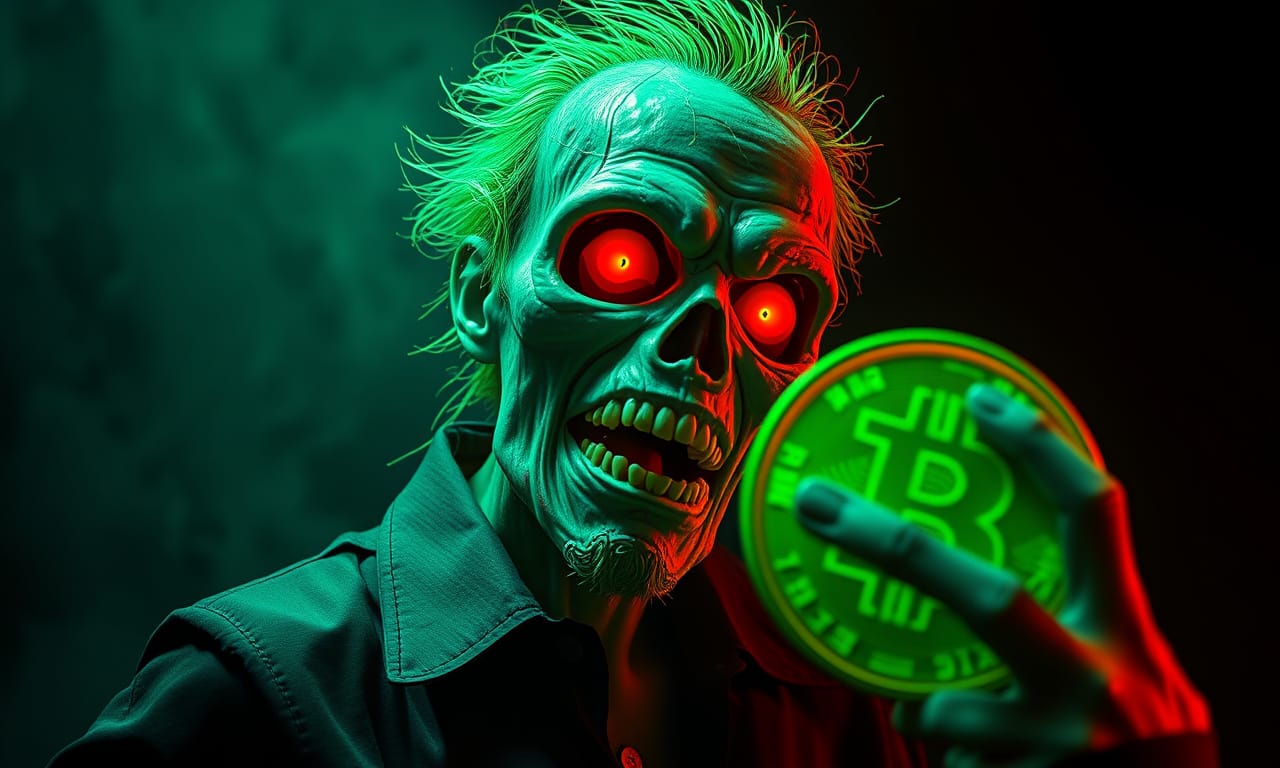
Hook: When the Music Stops, Some People Just Buy More Speakers
You ever watch one of those nature documentaries where the lemmings are just happily trundling towards the cliff edge? The narrator's voice is all calm and British, explaining the tragic, unstoppable march of instinct. That's what reading this report feels like. The headline, a perfect little nugget of crypto absurdity, says it all: 'South Korean retail keeps buying ether hoarder BitMine despite 80% drop: Report'. Not 'considered buying'. Not 'accumulating on dips'. They are *keeps buying*. Present tense. Active. As if an 80% evaporation of value is not a catastrophe, but a Black Friday sale on future pain. It's not investing; it's a form of mass financial masochism, and I'm here with the popcorn.
The Facts: The Great Korean ETH Sinkhole
Let's get the cold, hard, depressing numbers out of the way. BitMine isn't a mine. It's not a rig farm in Siberia. It's a decentralized autonomous organization (DAO) - a fancy term for a crypto fund with delusions of grandeur - that has one primary, singular, obsessive function: to hoard Ethereum. Its treasury strategy is less 'sophisticated asset management' and more 'digital dragon sitting on a pile of shiny ETH'. The report, which should be printed on black-edged paper, details how this thing has cratered. We're talking an 80% drawdown from its peak. If you put in $10,000 at the top, you're now holding a bag worth roughly two grand and a profound sense of regret.
And yet. AND YET. The on-chain data doesn't lie. Wallet analysis shows a consistent, stubborn inflow of funds from retail-sized wallets, predominantly traced back to South Korean exchanges. While the 'smart money' - the VC funds and early whales - have been quietly (or not so quietly) exiting stage left, Mr. and Mrs. Kim in Seoul are dollar-cost-averaging their way into oblivion. They're not buying the dip; they're buying the entire collapsing mine shaft. The narrative around 'South Korean retail keeps buying ether hoarder BitMine despite 80% drop: Report' isn't just a data point; it's a psychological case study.
Market Impact: What Happens to These Bags?
Okay, so a bunch of people are setting money on fire. What does it mean for the rest of us? For BTC and ETH, directly? Probably very little. BitMine is a rounding error in the grand scheme. But it's a symptom, a canary in a very expensive coal mine.
- Bitcoin (BTC): Unaffected. This is an altcoin story. Bitcoin maximalists are pointing and laughing, using this as Exhibit Z in their case against 'shitcoinery'. It reinforces BTC's narrative as the digital gold - the stable(ish) store of value while the alts perform circus tricks without a net.
- Ethereum (ETH): Ironic, isn't it? This fund hoards ETH, which should be bullish for the asset. But its spectacular failure is bearish for the 'ETH as productive asset' narrative. If a fund designed to hold and benefit from ETH can't make it, what does that say? It creates a subtle, nagging FUD that maybe just holding ETH isn't enough. You need staking, DeFi yields, something. Pure HODLing might be dead.
- Altcoins (The Rest): This is the real contagion zone. BitMine is a proxy for the entire high-risk, high-narrative altcoin DAO/treasury space. If this fails - and it is failing - it pulls the rug out from under similar projects. Why trust *this* fund with your money when *that* one just imploded? It's a credibility crisis for a sector built on little more than vibes and GitHub commits.
The bags these Korean retail investors are holding are likely permanent. This isn't a temporary markdown. This is a fundamental repricing of a broken product. They are providing the absolute last layer of liquidity - the exit liquidity for everyone who got in earlier and smarter.
Whale Watch: Where the Smart(er) Money Went
Let's play a game called 'Follow the Money That Didn't Vanish.' While the retail herd was charging into BitMine, the whales - the entities with enough capital to move markets and enough (usually) brains to read a chart - were doing the opposite. On-chain sleuths show a clear pattern: large wallets associated with BitMine's early backers and team began unloading positions months ago. They sold into strength during smaller rallies. They distributed. They took profits, or more likely, cut losses.
Where did that money go? Not into another magic internet money fund, that's for sure. A significant portion appears to have rotated into two places: 1) Blue-chip crypto - more BTC, more ETH, but held directly, not through a dysfunctional DAO. 2) Cold, hard stablecoins, parked on the sidelines waiting for the next real opportunity, or the next crash. The smart money isn't trying to catch a falling knife called BitMine; it's waiting for the noise to stop and the blood to dry before it even thinks about re-entering the altcoin slaughterhouse. This divergence - whale outflow vs. retail inflow - is the oldest and most reliable bear market signal in the book. It's the sucker's rally, defined.
The FUD Check: Is This Noise or Signal?
This is the core question. Is 'South Korean retail keeps buying ether hoarder BitMine despite 80% drop: Report' just a funny, bizarre anecdote? Or is it a critical signal for the market?
It's a deafening signal. Here's why.
First, it signals *peak pain is not yet in*. Capitulation happens when the last hopeful buyer finally gives up and sells. That is clearly not happening here. Hope is still alive. The 'they can't rug us if we own it all' mentality is still alive. As long as that's true, the price can, and will, go lower. True bottoms are built on despair, silence, and apathy - not on relentless, cheerful buying.
Second, it highlights the dangerous power of localized narrative bubbles. The Korean crypto scene is famously retail-driven and frenetic - the 'Kimchi Premium' wasn't born from institutional calm. A narrative can get locked in a geographic echo chamber, completely divorced from global reality. What looks like insane greed to the outside world looks like a patriotic duty to 'support the project' inside the bubble. This makes the situation even more precarious, as the buying is not based on global fundamentals, but on insular social pressure.
Third, it's a signal about the maturity of the market - or lack thereof. After multiple cycles, after Luna, after FTX, after countless rugs, the fact that this behavior still exists means we have learned nothing. Absolutely nothing. The same psychological traps - sunk cost fallacy, fear of missing out (FOMO) on the comeback, community tribalism - are ensnaring a new batch of players. This isn't noise; it's the recurring, tragic theme of crypto's main story.
Conclusion: The Final, Cynical Verdict
So here's the verdict, served neat with no chaser. The phenomenon described in the report 'South Korean retail keeps buying ether hoarder BitMine despite 80% drop: Report' is not an investment strategy. It is a financial cult. It is the endpoint of narrative-driven finance where the charts, the fundamentals, and the blatant evidence of failure no longer matter. All that matters is the story, and the story is that you're a diamond-handed hero fighting the evil short-sellers.
It will end badly. It always does. The retail buyers will eventually run out of money, or hope, or both. The social pressure will fracture. The 'discount' will reveal itself as a value trap with no bottom. And BitMine will either fade into obscurity or restructure into something unrecognizable, with the last retail bag-holders taking a 95%+ loss, wondering what happened.
For the rest of us, it's a masterclass. A live-action, real-time lesson in market psychology. Watch it. Study it. Take notes. But for the love of Satoshi, don't imitate it. The market isn't rewarding bravery right now; it's punishing stupidity. And buying into an 80% collapse because you think you're smarter than the market is the dictionary definition of the latter. The music stopped a long time ago. These folks aren't just left without a chair - they're buying the broken pieces of the chair, convinced they can glue it back together before the next song starts. Spoiler: the band has already left the building.